

National Gambling Act 7 of 2004
The National Gambling Act 7 of 2004 sets national rules for licensed gambling, prohibited activities and enforcement in South Africa. National and provincial governments share responsibility for gambling regulation under the Constitution. Regulations made under Section 45 set the maximum number of casino licences.
How South Africa's Gambling Law Developed
Before 1994, the Gambling Act 51 of 1965 barred most commercial gambling, apart from concessions in self-governing homelands. After the democratic transition, the Wiehahn Commission reviewed the social and economic case for licensed gambling. Parliament passed the National Gambling Act 33 of 1996, then replaced it with Act 7 of 2004 as technology and provincial regulation changed.
Act 7 of 2004 aims to keep gambling fair and free of criminal influence. It also protects minors and vulnerable people, sets national norms for the provinces, and provides enforcement tools for unlawful proceeds.
Why Unauthorised Online Casino Games Are Prohibited

Section 11 of the National Gambling Act governs unauthorised interactive games. Section 11 says that a person must not engage in or make available an interactive game unless authorised by the Act or another national law. The statutory definition of interactive gaming encompasses games of chance played through an electronic medium where the player wagers real money against the house or other players.
This statutory prohibition applies directly to online casino games, including digital slot machines, online roulette, online blackjack, online baccarat, and peer-to-peer online poker rooms. While Parliament passed the National Gambling Amendment Act 10 of 2008 with the initial intention of establishing a regulatory regime for interactive gambling, that legislation was never brought into force by presidential proclamation. Unauthorised interactive casino gaming remains unlawful in South Africa.
Sports Betting vs Interactive Casino Games
Under South African law, online sports betting and fixed-odds contingent wagering conducted through a provincially licensed bookmaker do not constitute prohibited interactive gambling. Bookmaker licenses allow digital betting on real sporting events and officially approved contingent outcomes, whereas digital casino games against the house remain prohibited under Section 11.
Casino Enterprise Supreme Court Ruling
The extraterritorial application of Section 11 was addressed by the Supreme Court of Appeal in the benchmark decision of Casino Enterprise (Pty) Ltd v Gauteng Gambling Board [2011] ZASCA 155. The appellant, an offshore corporate entity registered in Swaziland, operated online casino platforms targeting players residing in South Africa. The company argued that because its computer servers, software architecture, and financial accounts were situated outside South African territory, the gambling activity occurred beyond the jurisdiction of South African statutory law.
The Supreme Court of Appeal rejected the operator's jurisdictional defence. The player opened an account, placed wagers and viewed results in South Africa. Those steps gave the transaction a South African element, even though the servers were abroad. Foreign operators offering casino games to local players fall within Section 11.
When Unlawful Winnings Can Be Forfeited
Section 16 of the National Gambling Act deals with unlawful winnings. Money won through unlawful gambling does not vest in the player and may be forfeited.
Banks may identify and stop transfers tied to unlawful gambling. Section 16 provides for forfeiture of unlawful winnings, subject to the applicable process and evidence. A player may also struggle to enforce a payout claim against an illegal operator.
| Statutory Section | Subject Matter | Legal Implication | Statutory Penalty |
|---|---|---|---|
| Section 11 | Prohibition of Interactive Games | Online casino slots, table games, and poker prohibited | Fines up to R10 million or 10 years imprisonment |
| Section 14 | Excluded Persons Register | Operators prohibited from admitting excluded individuals | Regulatory sanctions, license suspension, mandatory refunds |
| Section 13 | Credit Restrictions | Operators strictly forbidden from extending credit for play | Administrative fines and severe license condition breaches |
| Section 16 | Forfeiture of Unlawful Winnings | Suspected unlawful winnings may be withheld and investigated | A High Court may order forfeiture of unlawful winnings |
| Section 45 | Casino License Quotas | National cap fixed at 41 physical casino concessions | Provinces cannot exceed statutory allocation limit |
Table 2: Key operative provisions of the National Gambling Act 7 of 2004.
FICA Compliance Duties
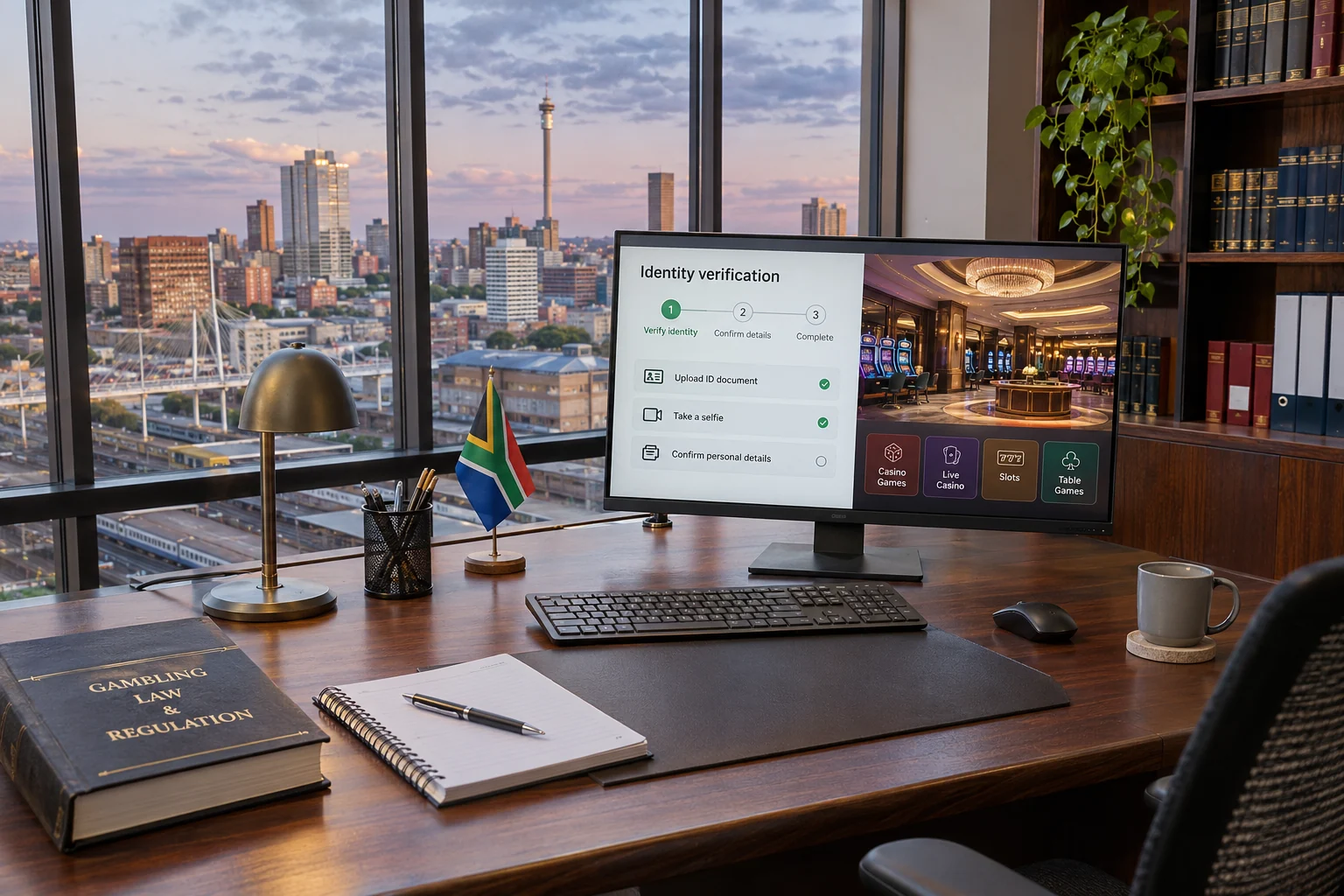
Gambling operators covered by the Financial Intelligence Centre Act 38 of 2001 (FICA) must carry out customer checks and report prescribed transactions:
- Customer Due Diligence (CDD): Operators must verify the identity of every patron before opening a digital wagering account or issuing casino payout checks, requiring valid identity documents and residential address verification.
- Cash Threshold Reporting (CTR): Operators must report all physical cash transactions exceeding the statutory threshold to the Financial Intelligence Centre within the prescribed timeframe.
- Suspicious Transaction Reporting (STR): Any transaction pattern indicating potential money laundering, terrorist financing, or sanctions evasion triggers an immediate statutory report under Section 29 of FICA.
- Politically Exposed Persons (PEPs): Heightened monitoring is mandatory for domestic and foreign prominent public officials to prevent illicit wealth accumulation.
National Casino Quota Allocation
Regulations made under Section 45 of Act 7 of 2004 cap casino licences in South Africa at 41. Gauteng holds the largest allocation with 7 casinos, followed by the Western Cape (5), KwaZulu-Natal (5), Eastern Cape (5), North West (5), Free State (4), Mpumalanga (4), Limpopo (3), and Northern Cape (3).
Enforcement and Criminal Penalties
Sections 82 and 85 of Act 7 of 2004 address offences and penalties for statutory contraventions. Any natural or juristic person convicted of offering unlawful gambling, aiding or abetting an unlicensed operator, or advertising prohibited gambling formats faces a fine not exceeding R10,000,000 (ten million rand) or imprisonment for a period not exceeding ten years, or both.
The National Gambling Board works with provincial inspectors and law-enforcement agencies on illegal gambling cases. Banks may also review payment channels used by unlawful operators.
Liabilities Under Act 7 of 2004
| User Scenario | Failure Mode & Trap | Statutory Sanction & Mechanism | Preventative Remedy |
|---|---|---|---|
| Individual resident wagers on Curacao-licensed slot site | Assuming offshore licensing overrides South African domestic legislation | Section 16 statutory forfeiture; bank freezes account under SARB Reg 10(1)(c) | Wager exclusively with bookmakers holding verifiable 9-digit provincial board licenses |
| Commercial landlord leases shop to internet gaming lounge | Claiming lack of knowledge regarding tenants electronic software activities | Section 82 criminal liability: R10M fine or 10 years imprisonment; asset seizure under POCA | Include strict statutory compliance clauses in leases and inspect premises quarterly |
| Patron wins R350,000 on illegal site and faces withdrawal refusal | Attempting to institute breach of contract litigation in South African courts | Action struck off court roll under ex turpi causa doctrine; ordered to pay taxed legal costs | Never deposit funds on platforms lacking provincial regulatory dispute jurisdiction |
| Operator extends credit line to VIP high-roller | Offering deferred settlement terms to retain high-turnover sports bettor | Absolute breach of Section 13; potential regulatory action against the licensee | Enforce strict pre-funded electronic wagering accounts cleared prior to bet acceptance |
Frequently Asked Questions
Why did the National Gambling Amendment Act of 2008 never take effect?
Although passed by Parliament, the 2008 Amendment Act required a presidential proclamation to take effect. Concerns raised by provincial regulators, civil society groups, and law enforcement regarding money laundering risks, underage gambling access, and social harm prevented the proclamation from being issued.
Can an individual player be prosecuted for using an offshore casino website?
Yes. Section 11 prohibits unauthorised interactive gaming. Under Section 16, suspected unlawful winnings may be withheld and investigated; the National Gambling Board may seek a High Court forfeiture order. A participant may also face prosecution under Section 82.
How does South African law treat online sports betting versus online casino games?
South African law draws a sharp statutory distinction between sports betting and interactive casino gaming. Sports betting and fixed-odds contingencies through a provincially licensed bookmaker are legal. Interactive casino games (slots, roulette, blackjack) remain illegal online.