

Gambling Payments and Exchange Controls
South African banks and regulators monitor payments linked to unlawful gambling and cross-border transfers. This page explains the roles of the Reserve Bank, the Financial Intelligence Centre and commercial banks.

Currency and Exchange Control Rules
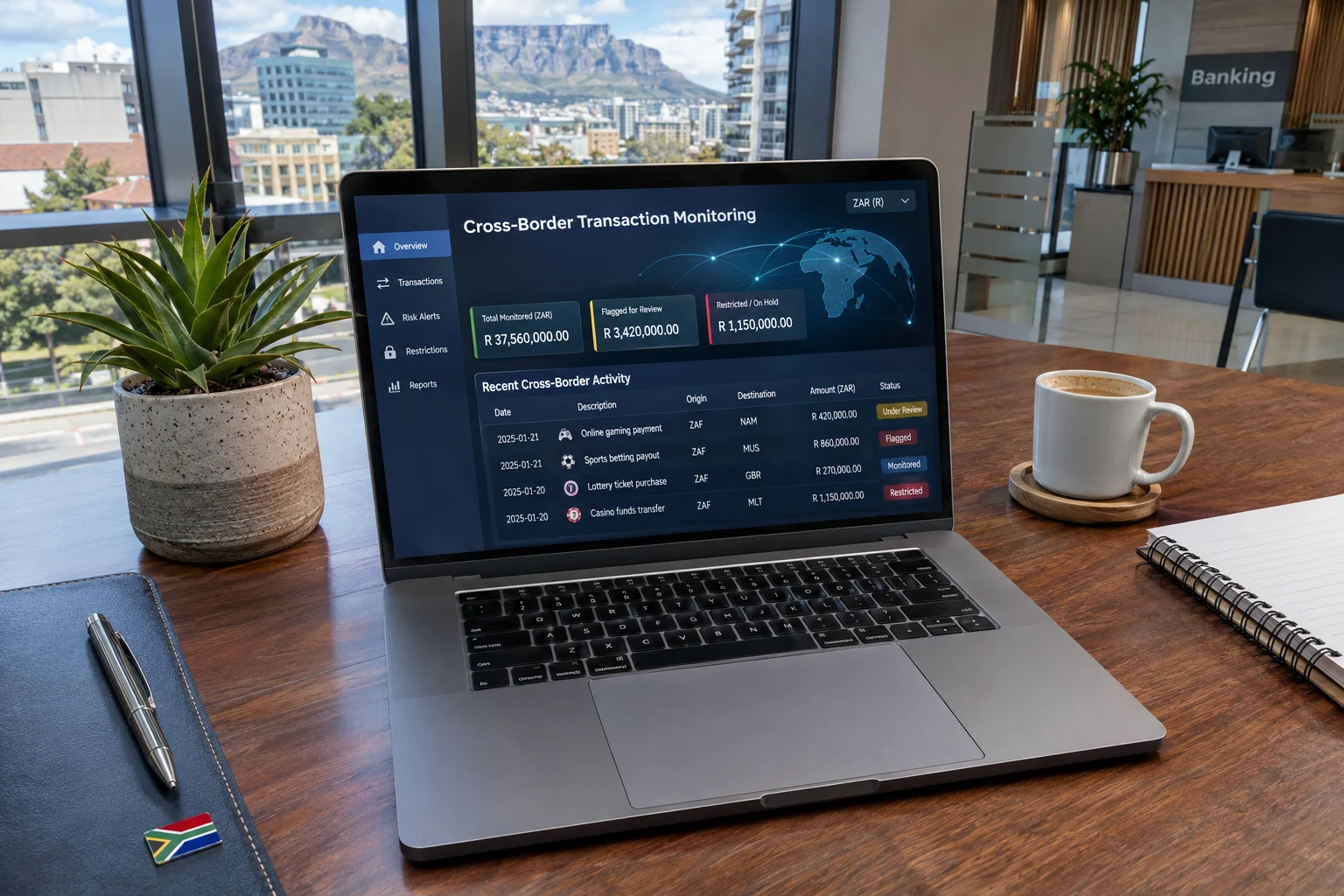
The financial restrictions governing online gambling are rooted in South Africa's statutory foreign exchange regime. Under the Currency and Exchanges Act 9 of 1933, the South African Reserve Bank exercises oversight over all capital outflows and foreign currency transactions entering or leaving the Republic.
Under Exchange Control Regulation 3(1), no person may, without prior authorization from the Financial Surveillance Department, export capital or commit foreign exchange to any entity outside the Republic. The Reserve Bank has explicitly established that:
- The transfer of South African Rand or foreign exchange to fund unauthorized offshore gambling represents an unlawful capital outflow.
- Authorised Dealers (commercial banks licensed to trade in foreign currency) are statutorily prohibited from processing wire transfers, card transactions, or letters of credit directed to unlicensed offshore gambling entities.
- Individuals who intentionally circumvent exchange control restrictions to fund offshore gambling accounts commit a statutory financial offense punishable by substantial monetary penalties and administrative restrictions on future foreign capital allowances.
MCC 7995 Payment Controls
The operational frontline of bank transaction blocking involves international payment card networks (Visa and MasterCard) operating through the Payments Association of South Africa (PASA) clearing switch.
Every commercial merchant account is classified by an international four-digit Merchant Category Code (MCC). The recognized global code for wagering is MCC 7995 (Betting, Casino Gaming, and Lottery Tickets). Under SARB directives:
- All domestic acquiring and issuing banks (Standard Bank, First National Bank, Absa, Nedbank, Capitec) configure automated transaction switches to intercept and decline any card transaction coded as MCC 7995 where the merchant identification (MID) originates outside the borders of South Africa.
- If a South African cardholder attempts to deposit funds into a foreign online casino using a Visa or MasterCard debit or credit card, the transaction is rejected automatically at the gateway with an 'Unauthorized Merchant Category' error message.
- Transactions within South Africa are permitted only when the acquiring merchant is verified as a provincially licensed South African bookmaker or casino holding an active license certificate.
Merchant Transaction Miscoding Fraud
To evade MCC 7995 card blocks, rogue offshore platforms frequently utilize shadowy intermediary processors that deliberately miscode gambling deposits as ordinary e-commerce retail, software purchases, or digital subscriptions. This practice constitutes financial fraud under the Cybercrimes Act, and banks utilize heuristic transaction monitoring to detect and blacklist these deceptive payment aggregators.
Automated FICA Monitoring

FICA requires covered financial institutions to identify customers, monitor risk and report prescribed transactions:
| Regulatory Mechanism | Governing Statute | Enforcing Authority | Operational Effect on Bank Accounts |
|---|---|---|---|
| MCC 7995 Card Blocking | SARB Exchange Control Directives & PASA | Commercial Clearing Banks (e.g., FNB, Absa) | Instant rejection of card deposits to offshore gaming portals |
| Inward Remittance Freezing | National Gambling Act Section 16 & FICA | Bank Forensic Units & NGB Legal Division | Immediate suspension of incoming payouts from foreign aggregators |
| Suspicious Transaction Reporting | FICA Act 38 of 2001 Section 29 | Financial Intelligence Centre (FIC) | Automated profiling of account holders engaging in illicit fund transfers |
| Crypto Travel Rule Audits | FAIS Act & FIC Directive 9 | Licensed Crypto Asset Service Providers (CASPs) | Mandatory identity tagging on all blockchain transactions above R5,000 |
| Foreign Exchange Re-Assessment | Currency and Exchanges Act Section 9 | SARB Financial Surveillance Department | Administrative fines and temporary revocation of Single Discretionary Allowance |
Table 3: Technical financial restrictions enforcing gambling prohibitions across South African banks.
Under Section 29 of FICA, commercial banks must file a formal Suspicious Transaction Report (STR) whenever an account displays transaction velocity or structuring indicative of illicit gambling activity. Indicators triggering automatic review include:
- Repetitive small round-amount card deposits processed through foreign third-party payment aggregators.
- Sudden incoming wire transfers originating from known tax-haven jurisdictions (such as Curacao, Cyprus, or Malta) labeled as 'marketing commissions' or 'consulting payouts'.
- Rapid movement of funds from savings accounts to newly established virtual prepaid card accounts followed immediately by foreign card authorizations.
Financial Surveillance and Payment Controls
The Financial Surveillance Department (FinSurv) of the South African Reserve Bank operates as the central intelligence and enforcement hub restricting illicit capital flight. FinSurv issues binding administrative circulars to all Authorised Dealers (commercial banks), establishing mandatory parameters for monitoring electronic funds transfers and international credit card settlements.
Banks may flag transfers linked to unlawful gambling for review and report suspicious transactions. Whether funds can be frozen or forfeited depends on the legal basis and process in the particular case.
PASA Settlement Restrictions
At the domestic payment clearing level, the Payments Association of South Africa (PASA) and BankservAfrica enforce technical transaction blocking protocols. Real-time clearing engines scan transactional metadata for unauthorized merchant settlement identifiers.
When third-party payment aggregators attempt to facilitate domestic card deposits into illegal gaming portals, BankservAfrica's automated risk switches interdict the settlement batches, flagging the acquiring bank for regulatory compliance auditing. This domestic interdiction prevents unauthorized gaming networks from establishing durable clearing channels inside the South African banking grid.
Crypto Gateways and the Travel Rule

To bypass commercial banking card blocks, illicit gaming portals heavily promote cryptocurrency deposits (Bitcoin, Ethereum, Tether USDT). But the South African financial regulatory framework has evolved rapidly to close this loophole:
Under regulatory declarations issued by the Financial Sector Conduct Authority (FSCA), crypto assets are formally classified as financial products under the Financial Advisory and Intermediary Services Act 37 of 2002 (FAIS). All domestic Crypto Asset Service Providers (CASPs), including premier South African exchanges (such as Luno and VALR), must operate as licensed financial institutions and comply with FICA.
Under Financial Intelligence Centre Directive 9 (the Crypto Travel Rule), domestic crypto exchanges must collect, verify, and transmit sender and beneficiary identification data for all blockchain transactions. Domestic exchanges actively deploy blockchain analytic software (such as Chainalysis) to monitor wallet addresses, automatically freezing transfers directed toward known offshore gambling wallet clusters.
SARB and FICA Checks for Bettors
Ensure your online financial transactions remain 100% compliant with South African currency regulations:
Verify Recipient Bank Account is Registered at a South African Clearing Bank
Confirm that deposit recipients hold corporate accounts with Standard Bank, FNB, Nedbank, Absa, or Capitec under a licensed South African business name.
Statutory Reference: Exchange Control Regulation 10(1)(c)Ensure Transaction Gateway Utilizes Domestic Clearing Rails
Use certified South African instant EFT gateways (Ozow, SiD, Peach Payments) or local debit cards that authenticate via 3D Secure / One-Time PIN (OTP).
Statutory Reference: Payments Association of South Africa (PASA) StandardsAvoid Foreign E-Wallet Currency Conversions for Gaming Purposes
Do not fund international wallets (Skrill, Neteller) using local cards for the purpose of offshore gambling, as Authorised Dealers flag these transactions.
Statutory Reference: SARB Financial Surveillance Department DirectivesMaintain Accurate Records of All Sports Betting Deposits and Payouts
Retain digital transaction slips and FICA verification confirmations to prove the legitimate, capital windfall nature of winnings during SARS tax inquiries.
Statutory Reference: South African Revenue Service (SARS) Tax Guidelines