

Gambling Operator Licensing
Provincial authorities issue commercial gambling licences in South Africa. Applicants, key shareholders, officers and relevant suppliers face suitability and financial checks before approval; licensees must continue to meet their conditions afterward.

Licence Application Requirements
Provincial gambling acts and the National Gambling Act 7 of 2004 govern commercial licence applications. Applicants for casino, bookmaker or route operator licences must demonstrate integrity, financial capacity and operational competence. They must supply evidence for the board's suitability review.
Provincial application procedures may require public notices in a Government Gazette or newspaper. The notice sets the period and process for objections in that province.
Probity Checks and Beneficial Ownership
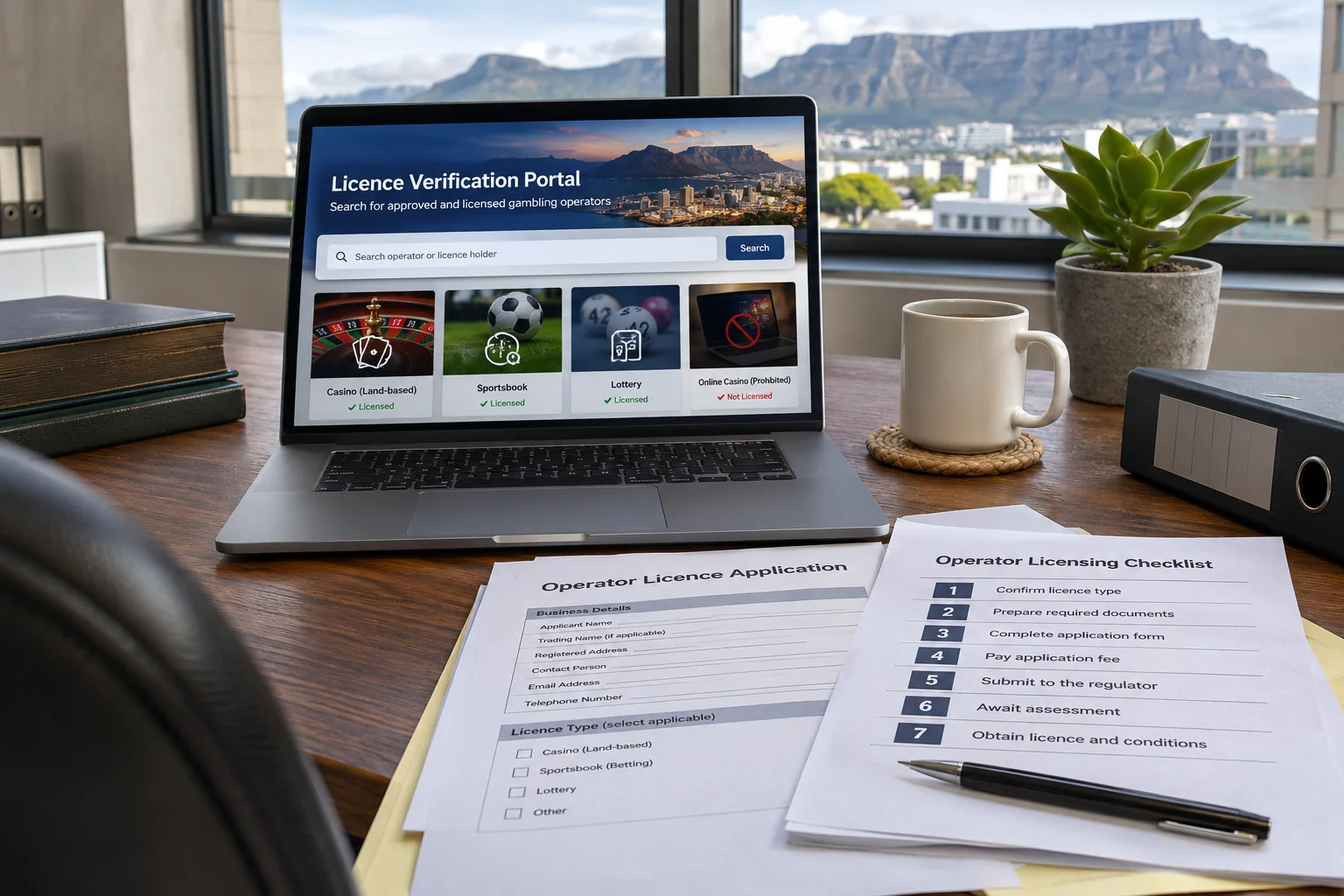
The core mechanism of licensing suitability is the probity investigation conducted by provincial board investigation units, frequently supported by external forensic accounting firms and the South African Police Service (SAPS) Criminal Record Centre.
Probity checks extend far beyond the corporate entity itself:
- Significant Beneficial Owners: Any natural or juristic person holding an equity or voting interest of 5% or more in the applicant must submit comprehensive Personal History Disclosures (PHDs).
- Financial Background Checks: Applicants must disclose full financial histories spanning ten years, including audited financial statements, tax clearance certificates from the South African Revenue Service (SARS), bank records, and asset declarations.
- Criminal and Regulatory Disqualifications: Any previous conviction for fraud, forgery, perjury, theft, or gambling offenses permanently disqualifies an individual from holding a key person or operator license.
- Civil Litigation and Judgments: Extensive court record searches are conducted to detect ongoing disputes, insolvency proceedings, or unsatisfied debt judgments.
The 5% Beneficial Ownership Rule
Section 38 of the National Gambling Act dictates that no person may hold a financial interest of 5% or more in a licensed operator without obtaining prior written approval and a certificate of suitability from the relevant provincial licensing board.
B-BBEE Licensing Requirements
In alignment with national socio-economic policy, gambling licensing in South Africa serves as an active instrument of economic transformation. Provincial boards enforce mandatory Broad-Based Black Economic Empowerment (B-BBEE) criteria under the Broad-Based Black Economic Empowerment Act 53 of 2003 and the relevant sectoral codes.
License applicants are evaluated on ownership equity held by historically disadvantaged individuals, executive management representation, skills development investments, supplier diversity, and enterprise development commitments. Casino resort concessionaires are routinely required to commit a specific percentage of their annual revenue to regional corporate social investment (CSI) projects within surrounding communities.
Gaming Equipment and SANS 1718

Commercial operators cannot deploy gaming hardware or software without external technical certification. The South African Bureau of Standards (SABS), in collaboration with the National Gambling Board, established the SANS 1718 technical standards series governing gaming equipment:
| Standard Number | Technical Scope | Core Regulatory Requirement | Testing Laboratory Role |
|---|---|---|---|
| SANS 1718 Part 1 | Casino Equipment and Table Games | Security seals, roulette wheel geometry, card shoe integrity | Physical laboratory inspection and precision calibration |
| SANS 1718 Part 2 | Electronic Gaming Machines (Slots) | Random number generator (RNG) verification, minimum RTP 80% | Source code audit, mathematical simulation testing |
| SANS 1718 Part 3 | Monitoring & Control Systems | Central reporting, continuous data integrity, transaction logs | Network architecture verification and stress testing |
| SANS 1718 Part 4 | Limited Payout Machines (LPMs) | CEMS protocol compliance, R5 stake and R500 prize hard caps | Firmware hash verification and communications validation |
| SANS 1718 Part 8 | Sports Betting & Wagering Systems | Audit trail security, bet placement timestamps, ticket integrity | Software architecture and database resilience testing |
Table 4: Technical certification standards enforced across South African gaming systems.
All electronic gaming machines (EGMs) must be tested by an accredited testing facility, such as GLI Africa or BMM Testlabs. The testing laboratory generates an official Certificate of Compliance certifying that the equipment software hash and hardware configurations strictly match approved specifications before installation on the gaming floor.
FICA Duties for Licensed Operators
The Financial Intelligence Centre Act 38 of 2001 (FICA), as amended by the Financial Intelligence Centre Amendment Act 1 of 2017, places South African commercial gambling operators at the forefront of the national Anti-Money Laundering and Combating the Financing of Terrorism (AML/CFT) architecture. Under Item 1 of Schedule 1 of FICA, person holding a casino license, bookmaker license, totalisator permit, or route operator concession is designated as an Accountable Institution.
A licensee covered by FICA must maintain a Risk Management and Compliance Programme (RMCP) and perform customer due diligence when required. Identity checks and transaction reporting follow the applicable FICA rules.
Failure to file Cash Threshold Reports (CTRs) or Suspicious and Unusual Transaction Reports (STRs) under Sections 28 and 29 of FICA exposes operators to administrative sanctions issued by the Financial Intelligence Centre, including financial penalties running up to R50 million per violation, alongside severe regulatory review by the relevant provincial gambling board.
Ongoing Licence Conditions
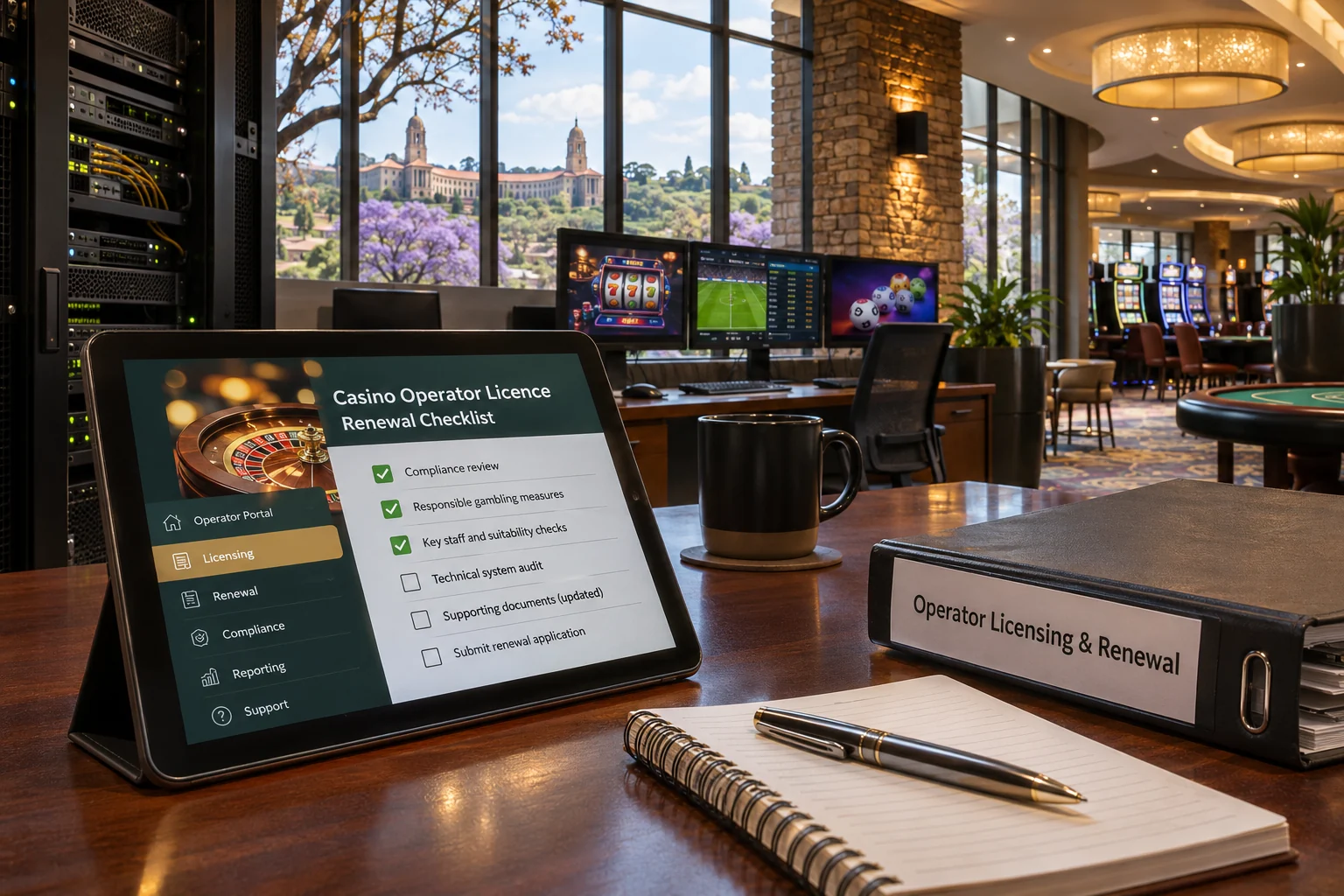
Obtaining a license represents merely the initial step; maintaining authorization requires adhering to ongoing conditions of license:
- Central Electronic Monitoring System (CEMS) Connection: All Limited Payout Machines nationwide must maintain active data communication with CEMS to ensure real-time regulatory oversight of stakes, payouts, and taxes.
- Surveillance Coverage: Land-based casinos must operate closed-circuit television (CCTV) systems capable of continuous recording of all cash count rooms, table game activities, and cashier cages, retaining high-definition footage for a minimum statutory period.
- FICA Compliance Audits: Operators must submit annual AML/CFT compliance reviews verifying staff training, risk management programs, and cash threshold reporting records.
- NRGP Funding Contributions: Operators must pay mandatory monthly levies to support the National Responsible Gambling Programme, financing prevention education and free clinical treatment for gambling addiction.
Five-Stage Operator Vetting
Commercial applicants must satisfy each sequential statutory hurdle before receiving a provincial gaming license certificate:
Corporate Due Diligence & 10-Year Financial Forensic Audit
CIPC company registration verification, beneficial ownership disclosures for all 5%+ equity holders, audited accounts, and SARS clean tax clearance.
Statutory Reference: Section 38 National Gambling Act & Provincial Licensing RegulationsB-BBEE Transformation & Socio-Economic Commitment
External verification of Broad-Based Black Economic Empowerment equity ownership, management diversity, and regional Corporate Social Investment commitments.
Statutory Reference: B-BBEE Act 53 of 2003 & Tourism Sector Transformation ChartersSANS 1718 External Technical Software & Hardware Testing
Submission of slot firmware, random number generator algorithms, and wagering software to GLI Africa or BMM Testlabs for formal compliance certification.
Statutory Reference: SABS SANS 1718 Series & National Technical StandardsFICA Accountable Institution Registration & RMCP Formulation
Appointment of a certified AML/CFT Compliance Officer, drafting of Risk Management and Compliance Programme, and integration with the FIC goAML reporting portal.
Statutory Reference: Sections 21, 28, 29 & 43 Financial Intelligence Centre ActGazette Notice Publication & 21-Day Public Representation Window
Statutory notice publication in the Provincial Government Gazette and regional press allowing civic and competitor objections prior to formal board hearings.
Statutory Reference: Provincial Gambling Acts (Gauteng, Western Cape, KZN)