

Blocking Illegal Gambling Sites and Payments
Regulators and financial institutions can act against unlawful gambling services by investigating operators and restricting related payments. This page examines those measures and the treatment of unlawful winnings under Section 16 of the National Gambling Act.

Joint Agency Enforcement
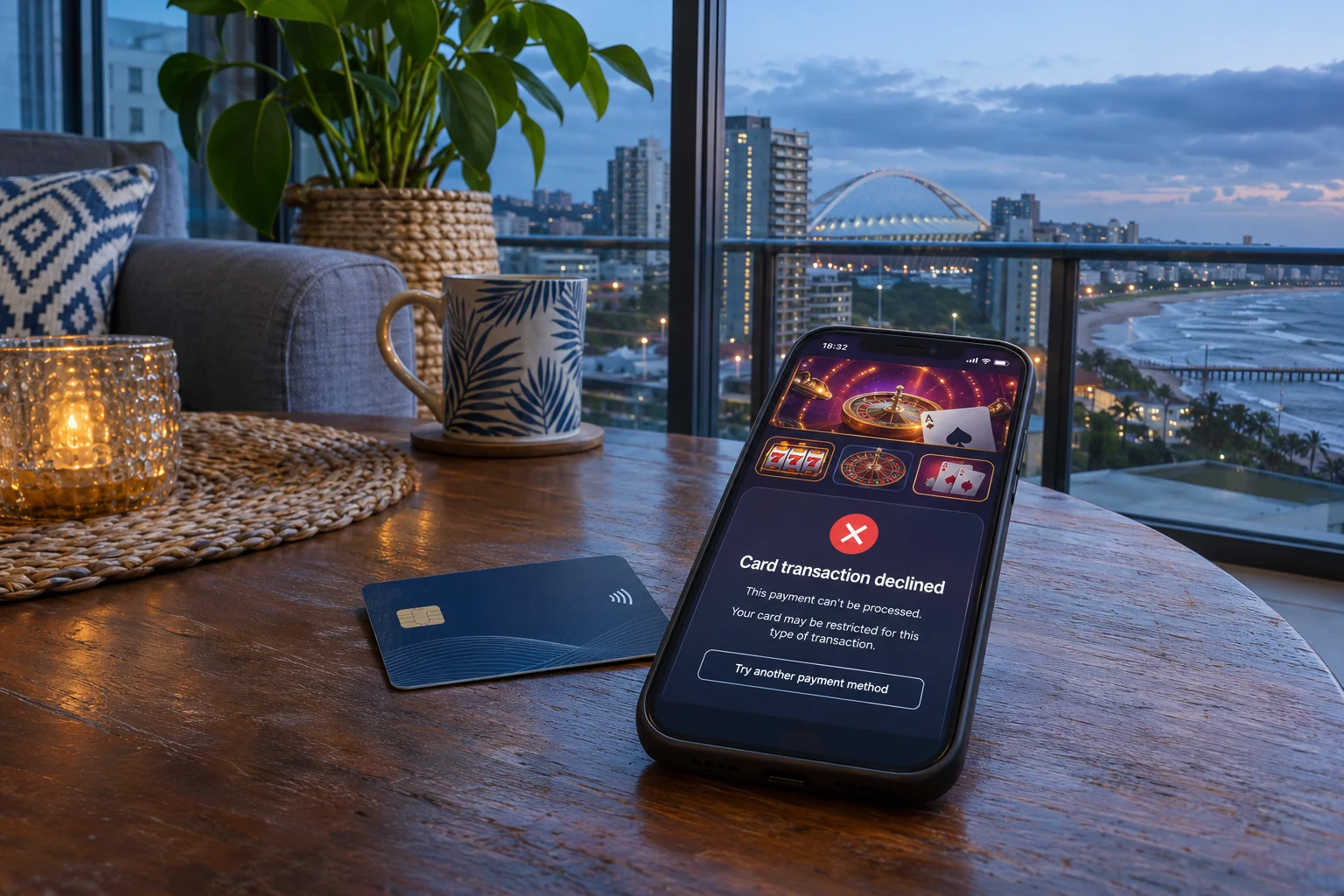
The suppression of illegal gambling in South Africa is managed through a formal inter-agency regulatory coalition:
- The National Gambling Board (NGB): Coordinates national enforcement strategy, monitors illegal marketing activities, and administers the statutory trust fund holding forfeited gambling winnings.
- The South African Reserve Bank (SARB): Enforces national Exchange Control Regulations under the Currency and Exchanges Act 9 of 1933, monitoring cross-border capital outflows and unauthorized foreign gaming merchant transfers.
- The Financial Intelligence Centre (FIC): Tracks financial transaction patterns, analyzes suspicious transaction reports (STRs), and shares intelligence regarding illegal payment aggregation networks.
- Commercial Clearing Banks (PASA Members): Standard Bank, First National Bank, Absa, Nedbank, and Capitec implement automated transaction blocking rules restricting unauthorized gambling payment flows.
- Internet Service Providers (ISPs): Comply with statutory court orders and administrative directives issued under the Cybercrimes Act 19 of 2020 and Electronic Communications and Transactions Act 25 of 2002.
Payment Controls and MCC Blocking
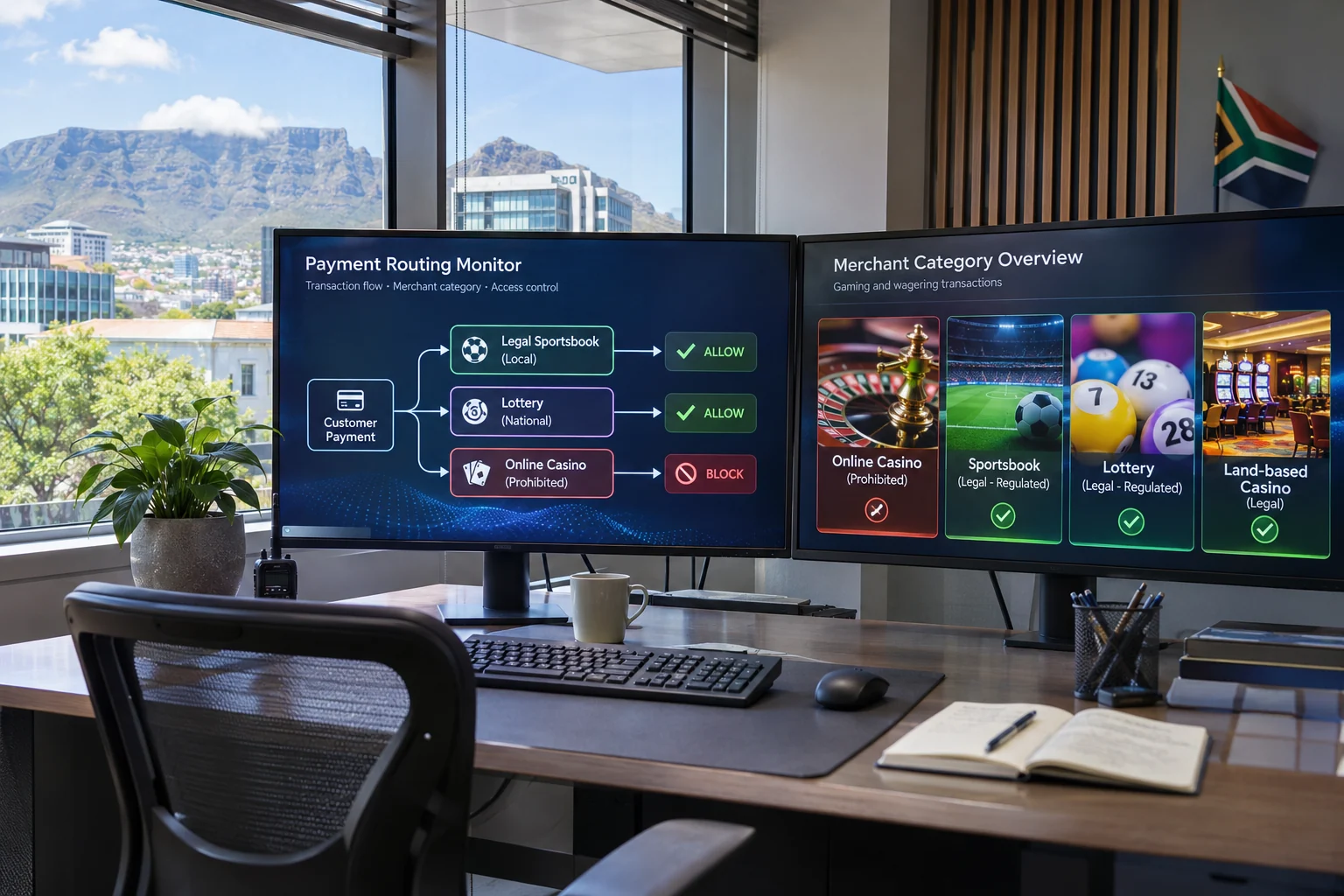
The primary operational mechanism utilized to dismantle illegal online gambling is the disruption of payment processing pipelines. In global banking, every commercial merchant is assigned a four-digit Merchant Category Code (MCC) by international card networks (Visa and MasterCard) designating the nature of its business.
The standard global code for gambling transactions is MCC 7995 (Betting, Casino Gaming, Lottery Tickets). Under directives issued by the South African Reserve Bank Financial Surveillance Department:
- South African commercial banks are statutorily prohibited from processing credit or debit card transactions coded as MCC 7995 if the merchant is an offshore entity lacking a South African provincial gambling board license.
- Card transactions submitted by foreign online casinos are automatically declined at the domestic acquiring bank switch.
- When rogue operators attempt to circumvent MCC 7995 by miscoding transactions as ordinary retail, digital subscription, or digital merchandise purchases, forensic automated transaction monitoring software flags anomalous transaction velocity and initiates merchant blacklisting.
Currency and Exchanges Act Violations
Under South African Exchange Control Regulations, transmitting funds out of the Republic to participate in illegal offshore gambling is a direct financial crime. Individuals attempting to move funds to unlicensed casinos face financial penalties and potential freezing of foreign exchange facilities.
Payments, accounts and VPNs
Can I use an electronic wallet like Skrill or Neteller to bypass South African gambling blocks?
No. The South African Reserve Bank and Financial Intelligence Centre monitor electronic wallet funding channels. E-wallet services operating in South Africa are required to restrict transactions originating from or directed to unlicensed gaming merchants, and banks routinely block card funding of unvetted gaming wallets.
What happens to my bank account if a payment from an illegal casino is detected?
A bank may hold the payment for review and ask for documents. It can report suspicious activity to the relevant authorities; forfeiture requires the applicable legal process.
Is using a VPN to play at an offshore online casino legal in South Africa?
No. Using a Virtual Private Network (VPN) does not alter the legal reality of the transaction. Under the Supreme Court of Appeal precedent in Casino Enterprise, playing an interactive casino game while physically situated inside South Africa remains illegal, regardless of IP masking.
How Unlawful Winnings Are Forfeited

The statutory mechanism for confiscating unlawful gambling winnings is established by Section 16 of the National Gambling Act 7 of 2004:
| Enforcement Step | Acting Authority | Statutory Process | Legal Mandate |
|---|---|---|---|
| Step 1: Transaction Interception | Commercial Clearing Banks (e.g., FNB, Standard) | Automated compliance filters identify foreign casino payout | Exchange Control Regulations & FICA Act 38 of 2001 |
| Step 2: Account Freezing | Bank Anti-Fraud & Regulatory Units | Suspicious incoming transfer placed in holding suspense account | Bank Compliance Mandate & Section 16(1) of NGA |
| Step 3: Formal NGB Referral | Commercial Bank to National Gambling Board | Notification submitted to NGB with transaction audit trail | Section 16(2) National Gambling Act Reporting |
| Step 4: High Court Forfeiture Order | National Gambling Board Legal Division | Application for civil forfeiture to National Revenue Fund | Section 16(3) High Court Civil Confiscation |
| Step 5: Trust Account Transfer | National Gambling Board & Treasury | Confiscated funds deposited into NGB Trust for state benefit | Section 16(4) Permanent Asset Transfer |
Table 5: Step-by-step statutory forfeiture process for unlawful gambling winnings in South Africa.
When an individual manages to request a withdrawal from an offshore online casino into a South African bank account, the receiving bank's compliance systems intercept the incoming wire transfer. The funds are frozen, and the player is required to provide formal proof of the legitimate commercial origin of the funds.
When it is established that the funds represent winnings from unlawful interactive gambling, the money is legally forfeited. Under Section 16(3), the player receives zero compensation, and the funds are permanently transferred to the National Revenue Fund.
Crypto Betting and Exchange Controls
To bypass traditional commercial banking blocks, rogue offshore gaming platforms increasingly promote cryptocurrency deposits (Bitcoin, Ethereum, Tether USDT). But the South African financial regulatory framework has adapted swiftly to close this avoidance channel.
Crypto-asset service providers in South Africa are subject to financial-sector and anti-money-laundering rules. Paying an unlicensed casino in crypto does not make the gambling lawful, and recovery after a transfer can be difficult.
Cross-Border Payments and Suspicious Reports
The Financial Intelligence Centre operates automated data matching software that interfaces directly with South African commercial bank transaction logs. Remittance streams displaying indicators of illegal gambling fund transfers (such as rapid round-tripping of funds through newly opened accounts, repetitive transfers to foreign payment aggregators, or inconsistent wealth declarations) trigger immediate Suspicious Transaction Reports (STRs).
Where financial forensics confirm that funds represent proceeds from unlawful interactive gambling, the National Gambling Board petitions the High Court under Section 16 of the National Gambling Act for civil forfeiture, transferring the seized balances permanently into the National Revenue Fund.
ISP Cooperation and Domain Blocking
To limit consumer exposure to rogue gambling platforms, regulatory authorities pursue domain name system (DNS) blocking and search engine delisting:
- Judicial Domain Blocking Orders: The National Gambling Board petitions the High Court for civil injunctions compelling major telecommunications operators and internet service providers (Vodacom, MTN, Telkom, Liquid Intelligent Technologies) to implement DNS resolution blocks against confirmed illegal casino domains.
- Search Engine and Advertising Delisting: Major search engines operating in South Africa (such as Google South Africa) are formally notified of unlicensed operators, resulting in the removal of paid search advertising campaigns and organic search result demotions for domains operating without provincial licenses.
- Cybercrimes Act Enforcement: Under the Cybercrimes Act 19 of 2020, electronic communication service providers are mandated to assist regulatory bodies in preserving digital evidence and identifying individuals hosting unlawful gaming servers within South African data centers.
Bank Controls and Section 16 Forfeiture
| User Scenario | Failure Mode & Trap | Statutory Sanction & Mechanism | Preventative Remedy |
|---|---|---|---|
| Player attempts R80,000 withdrawal from offshore slot website to FNB account | Bank compliance flags payment routing from unvetted international merchant aggregator | Incoming transfer frozen; funds permanently forfeited to National Revenue Fund under Section 16 | Wager solely through bookmakers using domestic clearing systems and local PLA licenses |
| User utilizes Virtual Private Network (VPN) to bypass geo-blocking controls | Believing IP concealment legalizes participation in foreign live dealer games | SCA precedent establishes physical territorial jurisdiction; account closed and balance seized | Recognize that physical presence in South Africa governs legal status, not proxy IP addresses |
| Bettor converts R30,000 to crypto via local exchange to fund offshore site | Attempting to circumvent credit card merchant category code (MCC 7995) blocks | CASP compliance logs transfer under FICA Travel Rule; transaction reported to FIC | Avoid crypto-to-gaming remittance; utilize regulated Rand payment rails with licensed bookmakers |
| Player attempts to contest bank account freeze through commercial litigation | Asserting property ownership over casino jackpot proceeds under common law | High Court upholds statutory forfeiture under Section 16(1); player ordered to pay state legal costs | Do not initiate litigation over unlawful proceeds; statutory forfeiture is legally absolute |